Almost every statistic below comes from original research across six studies: the ROI of OKRs Benchmark (330 organizations), the 2026 OKR Benchmark Report (200 organizations), the OKR Intelligence Report (222 organizations), the OKR Pacing Benchmark (24,000 key result updates), the State of Goal Management (210 employees), and the Strategy Execution Benchmark (180 leaders).
OKRs have become the default goal-setting framework for high-growth companies, and the data on what they deliver is now specific enough to verify.
This guide pulls the most significant findings across all six — the ROI of OKRs Benchmark, the 2026 OKR Benchmark Report, the OKR Intelligence Report, the OKR Pacing Benchmark, the State of Goal Management, and the Strategy Execution Benchmark — covering ROI, adoption, execution, pacing, failure patterns, AI, goal-gaming, and strategy execution.
Key OKR Statistics at a Glance
The headline numbers, before the detail.
OKR Adoption Statistics
Adoption has outpaced mastery — high uptake, plenty of room left in execution.
Rapid recent uptake. 52% of companies using OKRs have run them for under three years, and 71% say they still haven't fully mastered the process.
Top-down introduction. 90% of companies introduce OKRs through their leadership team to drive alignment and governance from the top down.
Alignment stays the gap. 65% of teams admit their OKRs aren't clearly linked to company goals, which caps the impact of everything downstream. Teams that connect departmental OKRs to company objectives see stronger alignment and execution.
Why teams adopt. In a global survey, 61% of companies cited better alignment as a top reason and 61% cited performance improvement.
What objectives cover. In our own data, objectives split into business growth and revenue (40%), product development (35%), and marketing and customer acquisition (25%).
Dedicated roles. Over 80% of companies running OKRs have an OKR champion overseeing the process.
Communication intensity. The most successful OKR teams show 28% higher communication intensity around their goals.
Business Impact and ROI Statistics
The financial case is the headline finding, and the operational returns land just as fast.
1:25 return. Across 330 organizations, OKRs return $25 for every $1 spent running them.
Near-universal revenue growth. 98% report measurable revenue growth, with 61% pointing to direct revenue improvement.
Fast payback. 62% see measurable ROI within a single quarter.
Less wasted work. 95% report a reduction in wasted or misaligned work.
Faster decisions. 86% report faster decision-making after adopting OKRs.
Strategic clarity. 60% report measurable improvement in strategic clarity.
Vision understanding. 72% of employees in OKR-using companies understand the company vision, versus 50% without OKRs.
Confidence to adapt. 67% of employees believe their company can respond quickly to change, versus 50% without OKRs.
Higher satisfaction. 78% of employees in OKR-driven organizations report higher job satisfaction, versus 65% without.
Sales productivity. Sears saw an 8.5% lift in sales per hour per employee after rolling OKRs out to 20,000 people.
Revenue growth. One study found OKR-using companies grew revenue nearly 60% faster on average.
Goal achievement. Companies that implement OKRs are 39% more likely to achieve their goals than those without a structured framework.
Growth rate. Companies with well-implemented OKRs grew 2.5 to 4 times faster than those without.
Biggest benefit cited. Easier goal tracking leads at 22%, ahead of clearer priorities (21%), team alignment (17%), accountability (16%), execution (14%), and investor reporting (7%).
The Execution Gap
The gap between what OKRs can deliver and what most organizations capture is an execution problem.
Low work-to-OKR alignment. Only 5% of teams have more than 75% of their weekly work tied to an objective.
The middle is thin. The largest group — 45% — runs at 26–50% alignment, and a further 23% sit at 25% or below.
Inconsistent review. Only 49% of leaders review OKRs every week; the other 51% do so sometimes, rarely, or never.
The 1:25 return is being generated by organizations where fewer than half of all working hours are OKR-aligned, so the ceiling is still a long way up.
OKR Execution Habit Statistics
Five habits correlate most strongly with completion across the benchmark data.
Weekly check-ins. Teams with weekly check-ins complete 43% more OKRs than those reviewing monthly or ad hoc.
Skipping is fatal. Teams that skip check-ins entirely are 3x more likely to abandon OKRs altogether.
Time has a ceiling. Teams spending 45+ minutes a week perform worse than those under 30; the sweet spot is 15–20 minutes on blockers, decisions, and next steps.

Ownership gap. 50% of all key results have no named, single owner.
Ownership lift. Teams with clear single ownership per key result see 26% higher completion than those with shared or vague accountability.
Fast launch. Teams that get OKRs live in under a week see up to 50% higher completion than those that delay.
First 30 days. The opening month of a cycle strongly predicts the rest of the quarter.
Fewer goals win. Teams running one or two OKRs a quarter are twice as likely to hit them as teams running three or more.
Fewer KRs win. Objectives with one or two key results outperform those carrying four or more.
Retrospectives. Teams that run end-of-cycle retros complete 30–45% more OKRs the following quarter.
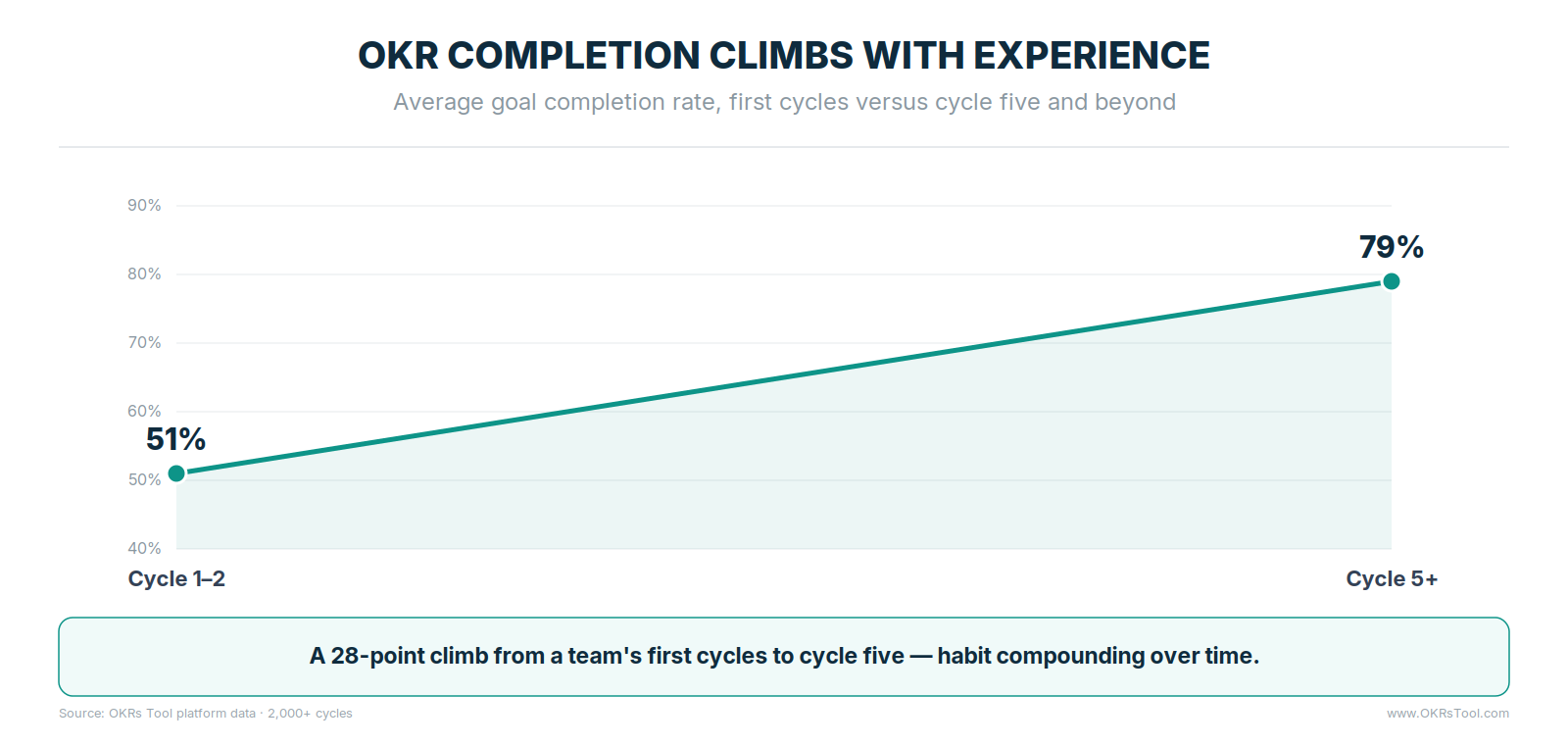
Compounding. By cycle five, teams complete 20.3% more goals than those in their first two cycles.
OKR Pacing Statistics
The OKR Pacing Benchmark analyzed 24,000 recorded key result updates across a complete cycle, and it reframes what good progress looks like.
Winning goals front-load. Key results that hit their target reach 50% by week 4, 74% by week 8, and 100% by week 12 — while those that miss sit at 20%, 32%, and 41% at the same marks.
The practical benchmark. Near 50% done by week 4, near 75% by week 8, complete by week 12.
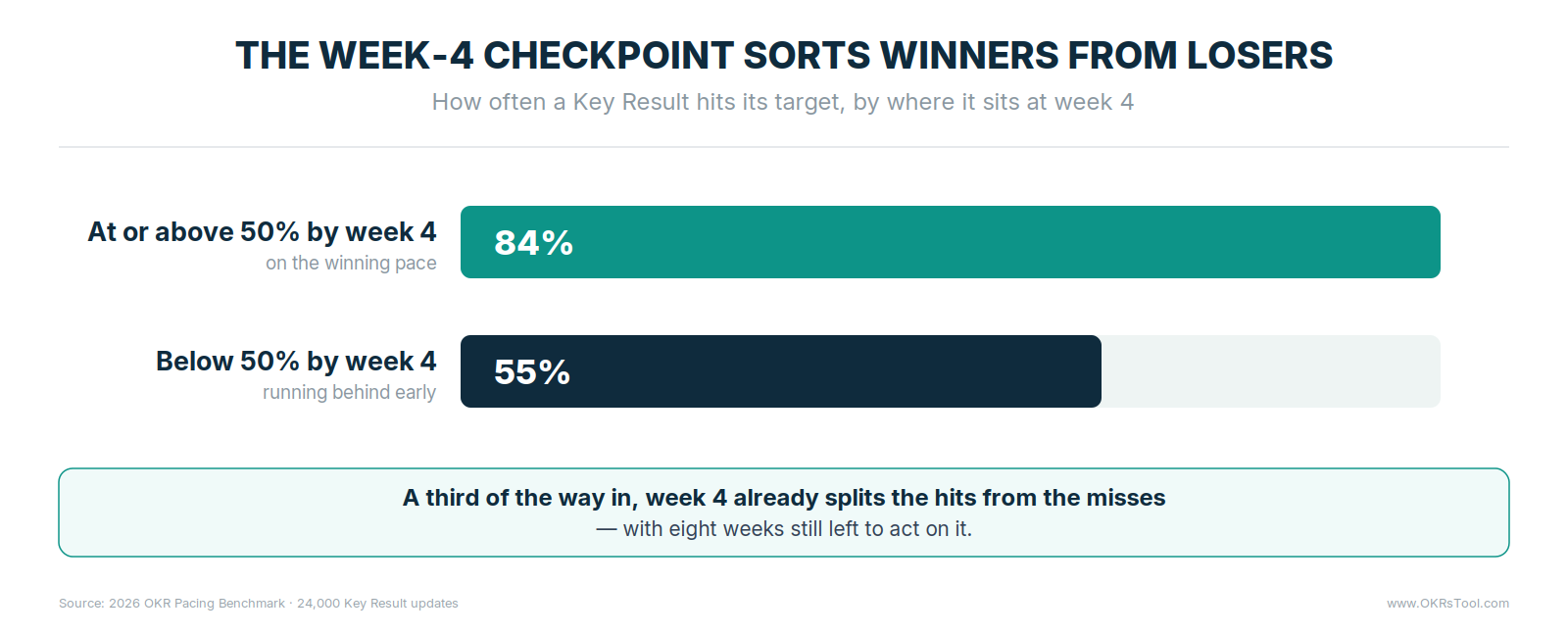
Week 4 is the tell. A key result at or above 50% by week 4 hits its target 84% of the time, versus 55% for one below that mark.
The first check-in predicts. Key results already moving at their first check-in hit 62% of the time, versus 27% for those still at zero.
Attention beats the final score. A key result touched once through the cycle hits 48% of the time; one tended repeatedly climbs past 70%.
OKR Failure Pattern Statistics
Across 330 organizations, the most common failure modes are structural.
Output-only key results — measuring activity, not outcomes — lead at 21%.
Too many goals set per team: 20%.
No named owner per key result: 17%.
Leadership not reviewing weekly: 13%.
No maintained check-in habit: 13%.
Tool fatigue from overcomplicated systems: 10%.
Why teams abandon. Among teams that dropped OKRs entirely, 35% blamed low engagement, 24% cited no clear ownership, and 12% cited complexity. Abandoned OKRs are more common than failed ones — abandonment happens when no system keeps the goals alive.
Goal-Gaming and Honesty Statistics
The State of Goal Management is the first study to measure goal-gaming directly rather than inferring it from completion data — 210 full-time employees at growing companies.
Gaming is near-universal. 92% admit to at least one form of goal-gaming.
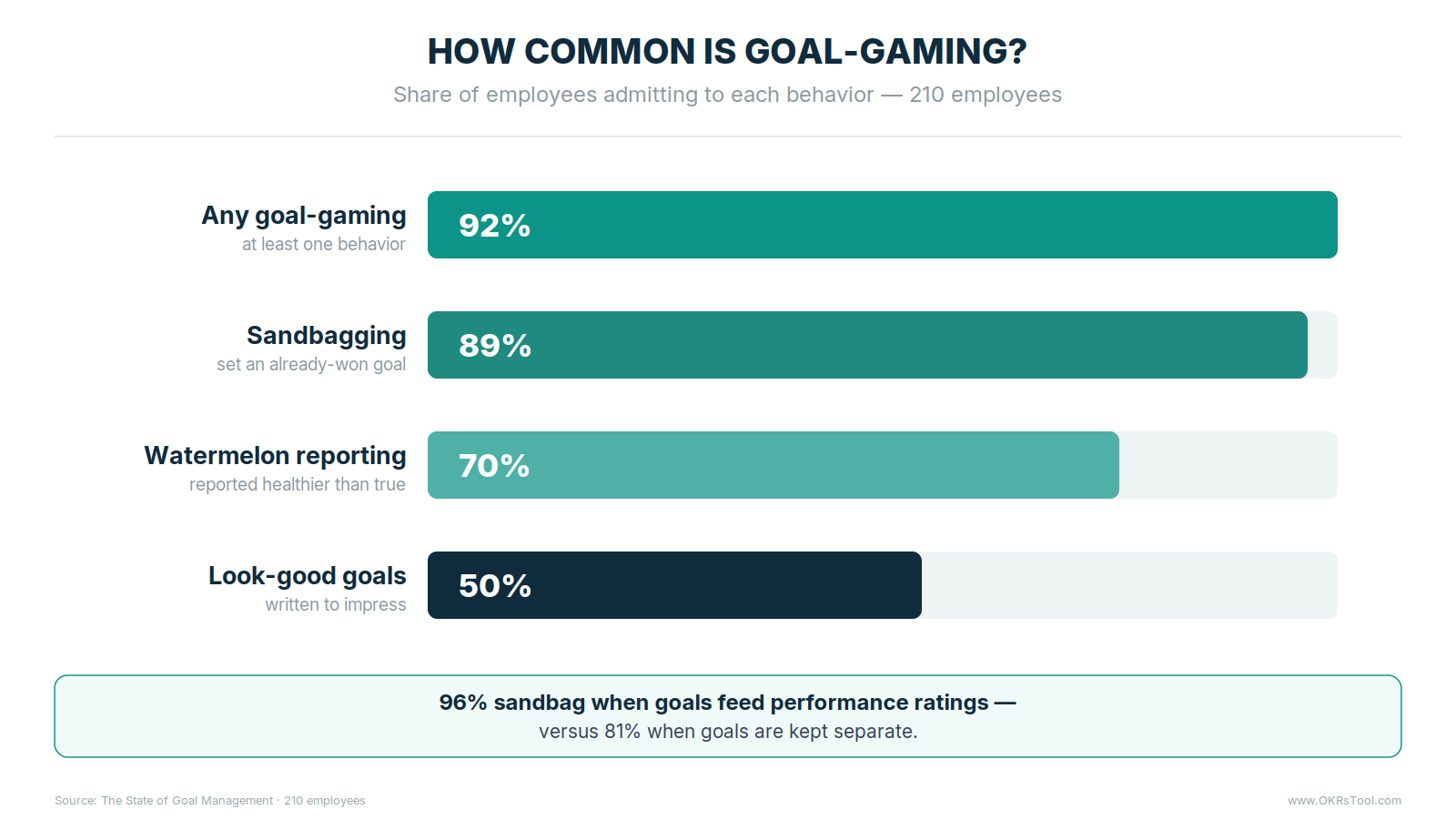
Sandbagging. 89% have set a goal they'd already mostly achieved.
Watermelon reporting. 70% have reported a goal healthier than they knew it to be.
Look-good goals. 50% have written a goal mainly to look good rather than to change anything.
All three at once. 43% admit all three behaviors in the same cycle.
Ratings drive it. 96% sandbag when goals directly affect performance ratings, versus 81% when goals are kept separate.
The tracker nobody misses. 34% say nothing about how they work would change if their goal tracker were deleted tomorrow.
Few can name the goals. Only 30% can name all their company's current top goals without looking them up.
The link between the two. Among employees who can't name company goals, 59% say nothing would change if their tracker vanished; among those who can, only 24% say the same.
Key Result Quality Statistics
From an analysis of 20,952 key results across 876 organizations.
Half aren't outcomes. 52% of key results were KPIs or tasks in disguise — measuring activity, not change.
Outcomes win. Teams that connect goals to outcomes rather than outputs are 30% more likely to hit them.
The weak verb. The most common underperforming key result verb is "Conduct" (100 instances) — a task.
The strong verb. The most common high-performing verb, from the platform data, is "Increase" (336 instances) — directional and measurable.
AI in OKRs
The OKR Intelligence Report covers 222 organizations, and AI is already in production.
In use now. 83% are actively using AI in their OKR process this quarter — not piloting, using it.
Calibrated trust. Only 13% use AI-generated OKRs as-is; 47% treat them as a strong starting point that needs refinement; 20% use AI for inspiration only.
Analysis vs writing. 34% use AI for analysis only (surfacing risks, flagging misalignment) and 31% for writing only.
Where it helps most. Among 178 active AI users, the biggest impact areas are writing better key results (51%) and identifying misalignment (49%).
Most proactive pattern. Teams using AI for both writing and analysis accept a low score on a missed OKR only 14% of the time, versus 35% for writing-only teams.
Top concern. Data privacy and security leads at 25%, ahead of output quality (19%) and leadership trust (16%).
Strategy Execution Statistics
The Strategy Execution Benchmark surveyed 180 strategy and operations leaders — the first study to measure where strategy decays after the plan is set.
Priorities go unremembered. In 86% of companies, most employees can't name the top strategic priorities unprompted.
Work doesn't ladder up. Only 7% of leaders say most daily work ladders up to strategy; nearly two-thirds put it at half or less.
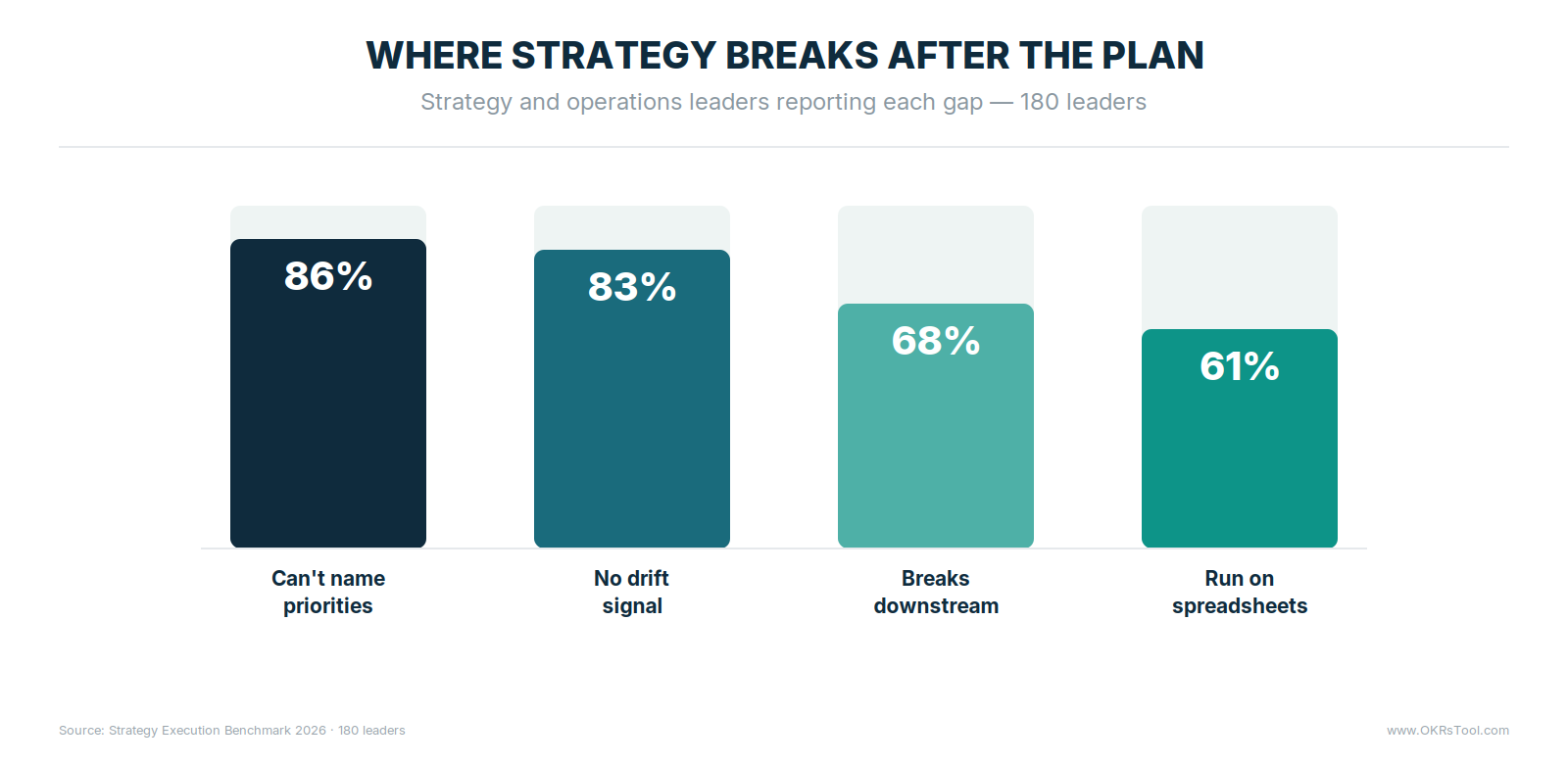
No drift signal. 83% of leaders get no automatic warning when a priority drifts off track.
Slow detection. 21% take a month or more to learn a priority is off track.
Failing priorities linger. When a priority is clearly failing mid-cycle, only 40% get formally revised or killed; the rest are dropped without a decision or limp to the end.
Breaks downstream. 68% of leaders say strategy breaks in sustaining and measuring, while only 23% point to the initial handoff.
Run on spreadsheets. 61% run strategy execution on spreadsheets, docs, or nothing central; just 22% use purpose-built strategy execution software.
OKR Software Market Statistics
Market size. The OKR software market was worth around $1 billion in 2022 and is projected to reach $5 billion by 2034, a 14.6% CAGR.
Regional growth. North America leads today; Asia-Pacific is growing fastest.
Spreadsheet holdouts. 40% of organizations still run OKRs primarily on spreadsheets rather than OKR software.
The return difference across approaches is stark.
Enterprise software costs more and returns less than spreadsheets, at 1:16. Purpose-built software returns 1:88 — more than three times the spreadsheet return and more than five times the enterprise return.
What the Data Tells You to Do Differently
The pattern across all six studies is consistent. OKR completion is predicted by structure — named ownership, weekly cadence, fast launch, honest scoring, and end-of-cycle retrospectives. The 1:25 return is a floor, generated before most organizations have applied all five habits consistently; the teams at 1:88 have applied them.
The State of Goal Management adds the layer completion numbers hide: 34% of employees say nothing would change if their goal tracker were deleted tomorrow. Improving completion matters, and building a goal system that's genuinely load-bearing matters more — a tracker no one would miss isn't shaping any behavior to begin with.
Data: the ROI of OKRs Benchmark (330 respondents), the 2026 OKR Benchmark Report (200 organizations), the OKR Intelligence Report (222 organizations), the OKR Pacing Benchmark (24,000 key result updates), the State of Goal Management (210 employees), and the Strategy Execution Benchmark (180 leaders).