OKR software splits into types that each solve a different problem — goal-writing, alignment visibility, or the weekly check-in habit. The tool you pick moves the number more than its feature list does: among teams already reviewing weekly, 74% hit their goals on dedicated software against 33% on spreadsheets. This guide maps the seven types to the problem each one solves.
The mistake that wastes the most money in this category is picking on feature count — buying an enterprise platform for a 90-person team because the comparison table had the most checkmarks.
A Goal-Setting Benchmark survey of 280 operations and strategy leaders found the opposite of what feature lists imply: which framework or tier a team runs is one of the weakest predictors of success, while a stack of ordinary habits — weekly review, continuous tracking, visible goals, real software — predicts almost all of it. The right type of OKR software is the one that makes those habits the path of least resistance for a team your size.
So the question isn't which tool has the most features. It's which type fits the problem you actually have, and which one your team will still be using to run OKRs in cycle two.
The seven types below are organized around that, each mapped to the stage and problem it solves best. They sit inside the wider practice of goal setting, where the same finding holds: the system around the goal decides more than the goal itself.
The Features That Actually Drive the Return
Before the seven types, it helps to know what to weigh them against. The return from OKR software doesn't come from the length of the feature list.
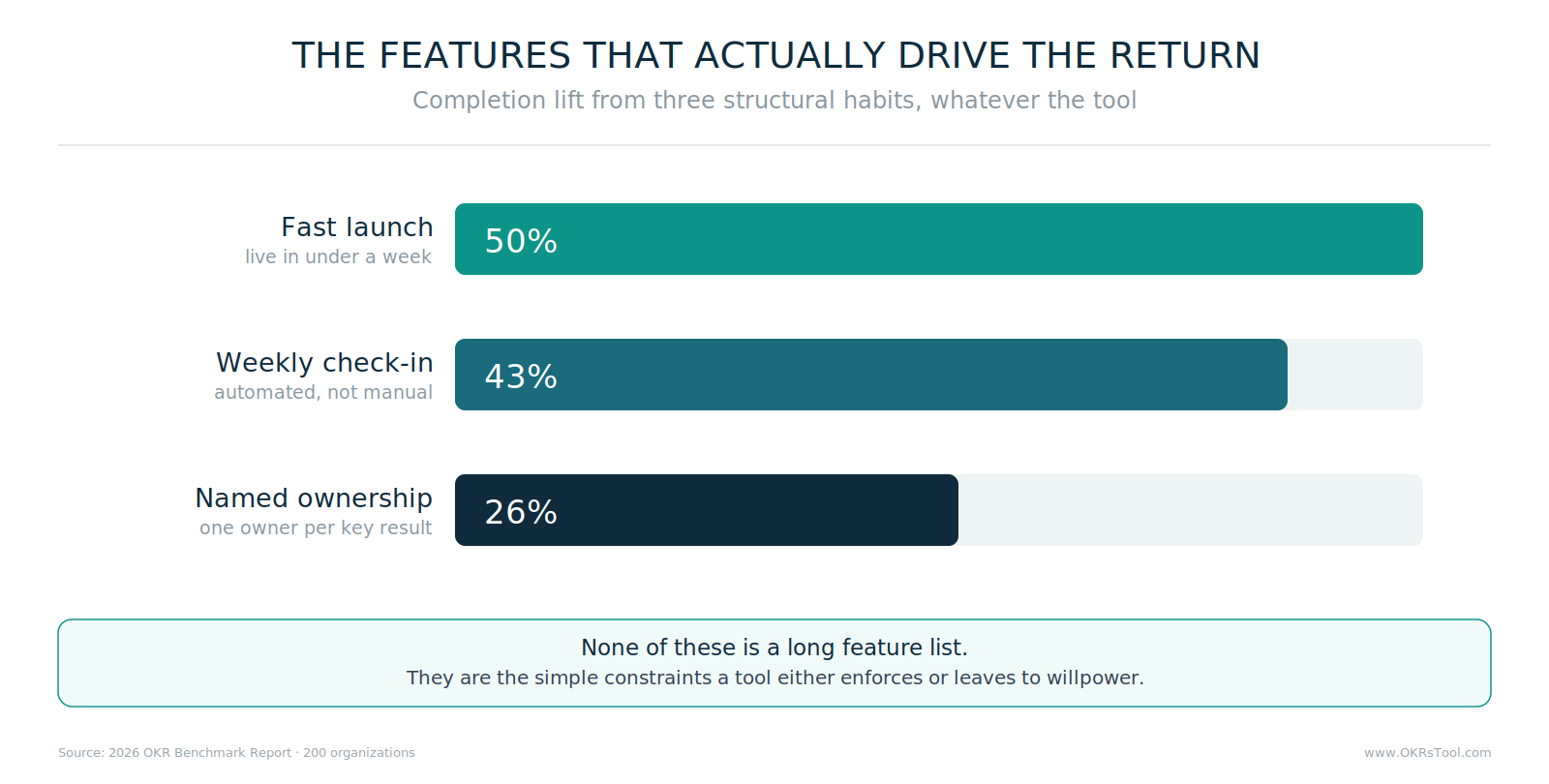
Three structural habits produce most of the measurable lift, and each is a simple constraint rather than a feature: getting live in under a week (up to 50% higher completion), an automated weekly check-in (43% more goals completed), and a single named owner on every key result (26% higher completion, against the 50% of goals that currently have no owner). A tool either enforces those or leaves them to willpower. That's the lens for every type below.
Quick Reference: The 7 Types
1. Purpose-Built OKR Platforms
Best for: growing teams (50–200 people) who need OKRs working this quarter.
These are designed for the quarterly goal cycle — planning, tracking, weekly check-ins, and end-of-cycle retrospectives — without the overhead of enterprise strategy software or the gaps of a spreadsheet.
The defining feature is execution infrastructure: automated weekly nudges, required ownership per key result, and a live alignment map on one platform showing how each team's work connects to company priorities. This category generates the bulk of the 1:88 ROI, because it makes the weekly habit structurally easy to keep.
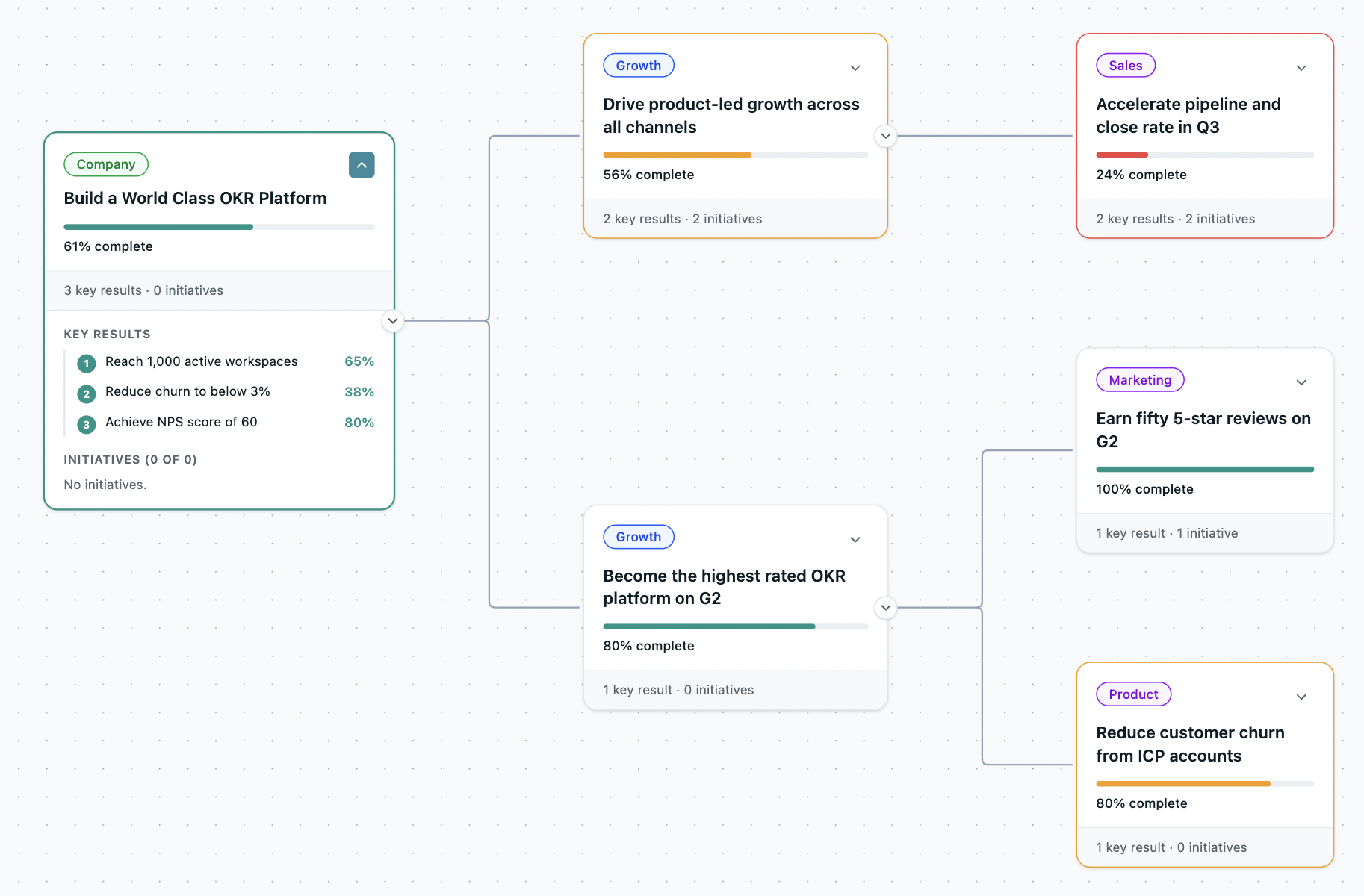
Look for automated check-in reminders rather than manual scheduling, required single ownership before goals go live, cascade visibility from company to team without a meeting, setup measured in days, and transparent pricing you can evaluate without a sales call.
Recommended: OKRs Tool, Tability, Perdoo, Mooncamp. Use this type when you've outgrown spreadsheets and need OKRs live before the quarter ends.
2. Enterprise Strategy Execution Software
Best for: large organizations (500+) with complex, multi-level strategy execution.
Strategy execution software goes beyond OKR tracking into full strategic-planning infrastructure: strategy maps, focus areas, KPI automation, and multi-level cascades across divisions and departments. They suit organizations with a dedicated strategy function and a review cadence protected from operational override.
Look for a strategy map connecting themes to OKRs to KPIs, live data integrations for automated tracking, multi-level governance, and enterprise security (SSO, SAML, audit trails).
Recommended: Cascade, Quantive, Betterworks. For teams under 200 this is usually the wrong type — the setup complexity and cost exceed the alignment benefit before you reach 300 people.
3. Performance Management Suites
Best for: HR-led organizations connecting OKRs to performance reviews and compensation.
Performance management software treats OKRs as one module in a broader people-management system, alongside 360 feedback, continuous check-ins, calibration, and compensation planning. The OKR Intelligence Report found 75% of organizations have formally linked OKR outcomes to performance decisions, and suites are built for making that connection structural.
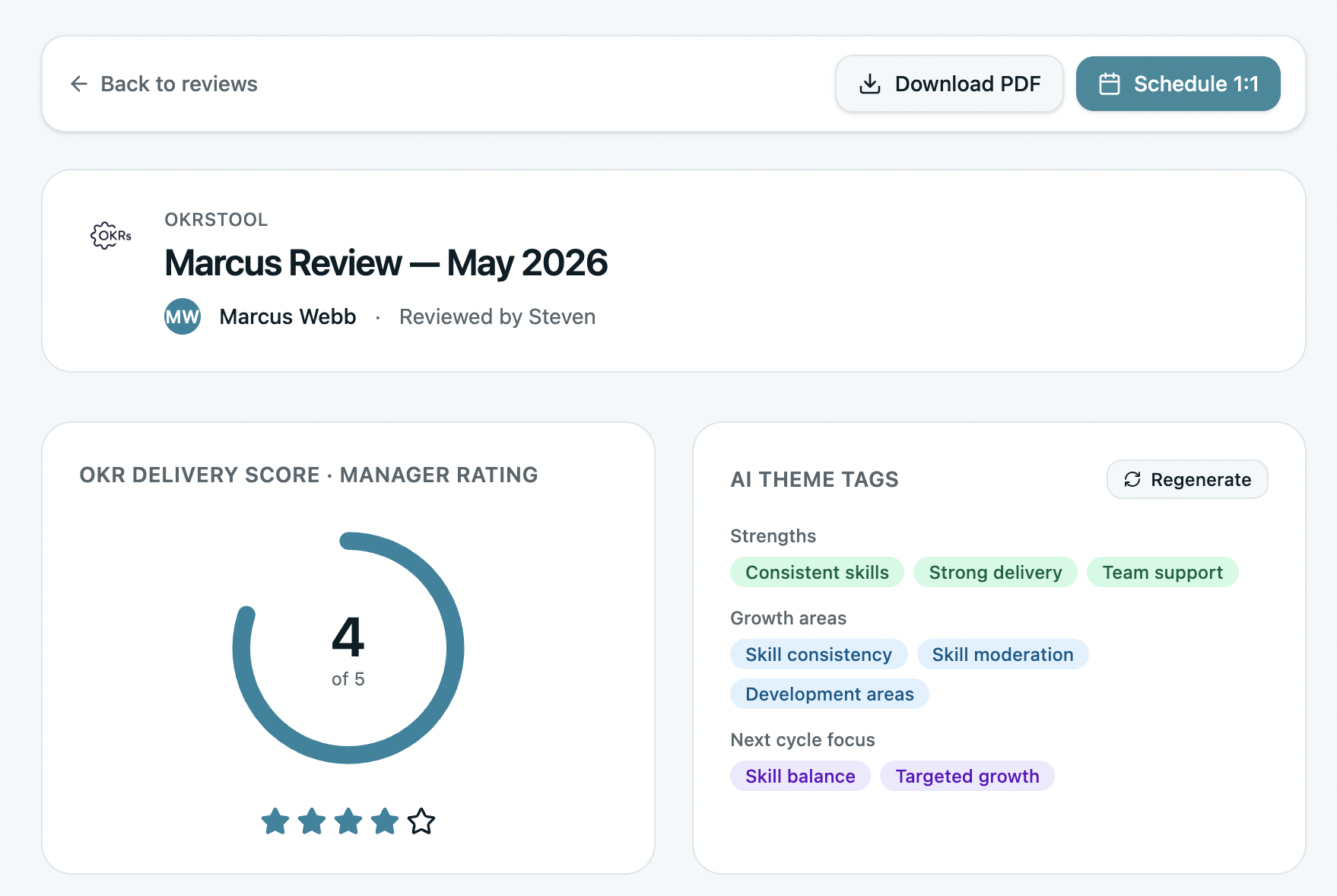
The trade-off is that the OKR module is rarely as strong as a purpose-built platform — but for teams that need goals, reviews, and development in one system rather than three tools, the consolidation is worth it.
Recommended: Lattice, Leapsome, 15Five. Use this type when goal delivery needs to feed ratings and compensation as one connected flow.
4. AI-Powered OKR Software
Best for: teams that want AI supporting both goal-writing and mid-cycle analysis.
AI in OKR software has moved past the drafting-assistant phase. The OKR Intelligence Report found that among 178 organizations actively using AI, 83% are using it this quarter, and the split between writing (51% impact) and analysis (49% impact) is closing fast — AI is becoming a strategic lens as much as a drafting tool.
The two highest-value uses are writing role- and context-aware outcome-based key results in seconds, and analysis: misalignment detection, at-risk flagging on progress velocity, and end-of-cycle synthesis across check-in data.
Recommended: OKRs Tool, Tability. Use this type when your team writes too many output-based key results — an analysis of 20,952 key results across 876 organizations found 52% were tasks or KPIs in disguise — or you want mid-cycle intelligence that surfaces problems before they become misses.
5. Microsoft 365 Embedded OKR Tools
Best for: organizations where Microsoft Teams is the primary workspace.
These put goal-setting, updates, and check-ins inside Teams, removing the context switch that breaks most mid-cycle update habits. The tool that lives where the work happens gets used: updating a key result takes 30 seconds inside a conversation the team is already having, rather than a deliberate switch to a separate platform.
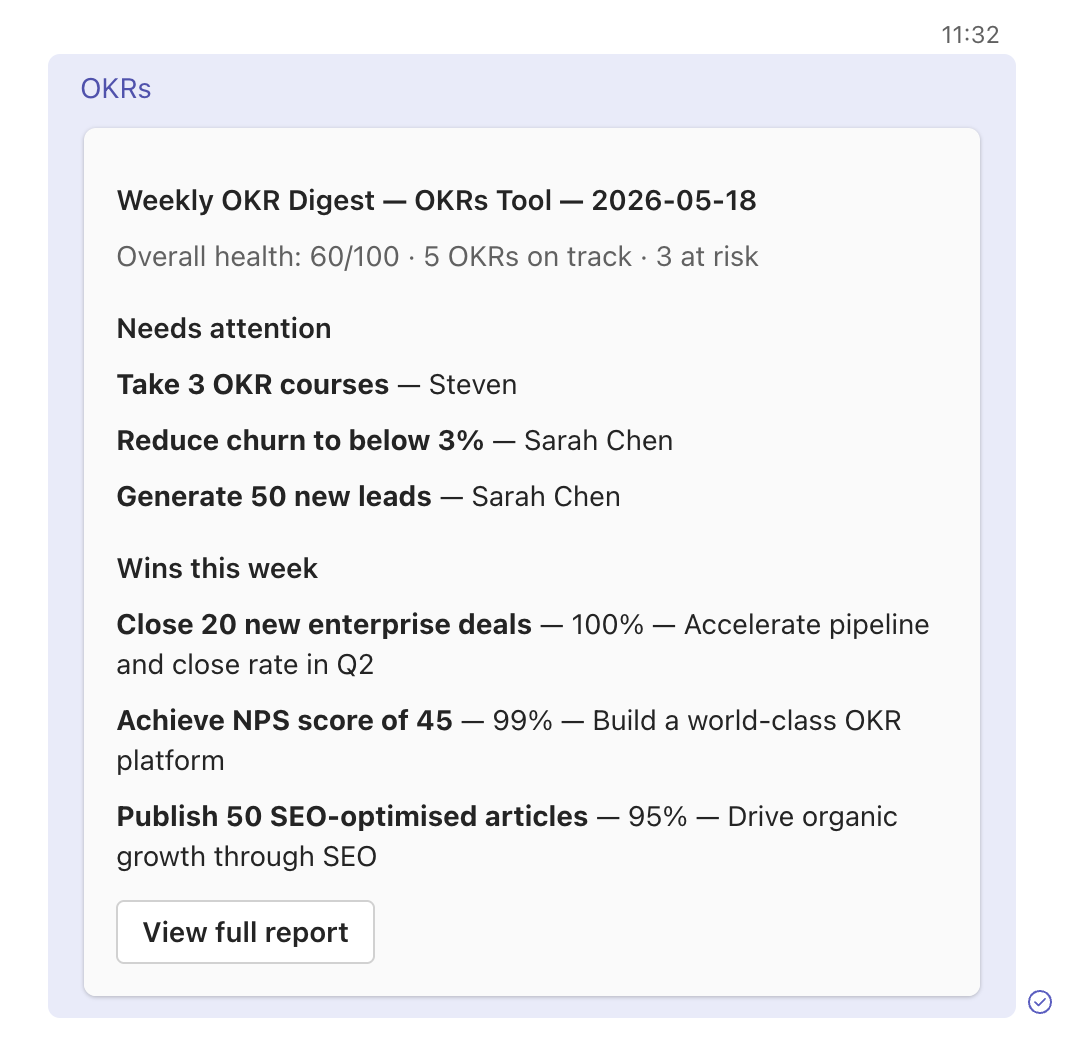
Microsoft discontinued Viva Goals in 2024, so teams migrating from it have the strongest case for this category, or for a purpose-built platform with a solid Teams integration. Look for native check-in flows rather than just a tab, Outlook and Teams notifications, and HRIS sync.
Recommended: Teamflect, OKRs Tool (Teams integration). Use this type when the main adoption barrier is switching tools mid-workflow.
6. Spreadsheets and OKR Templates
Best for: teams in their first cycle evaluating the framework before committing to software.
A spreadsheet can carry a team of 10 through a first OKR cycle in Google Sheets or Notion, and the process matters more than the tool that early. The limits show up around cycle three or four: no automated reminders, no alignment visibility, no at-risk flagging, and manual compilation of end-of-cycle data.
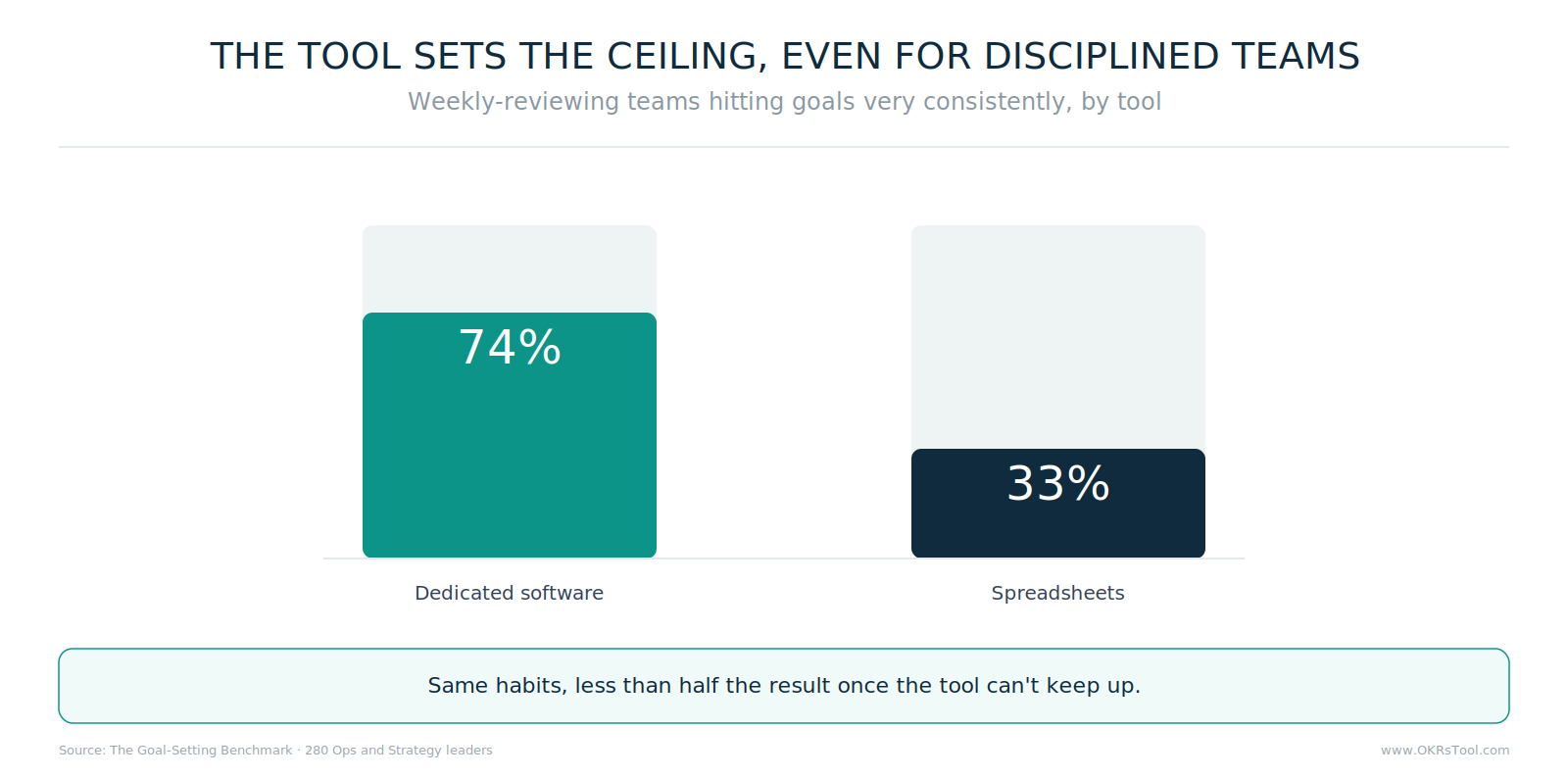
The benchmark puts a number on the ceiling. Hold the habits constant — a weekly review, progress kept current — and the tool alone accounts for a wide split: 74% of those teams hit their goals very consistently on dedicated software, only 33% on spreadsheets, and over a year the return runs 1:88 versus 1:25.
A spreadsheet carries the discipline early and loses its grip on it as the team grows. Upgrade when maintaining the sheet takes more time than it saves, usually around 15–25 people or after two to three cycles.
7. Free OKR Software
Best for: small teams (under 10) that need real OKR infrastructure at zero cost.
Several platforms offer free OKR software — real systems with goal setting, progress tracking, ownership, and check-in cadence, rather than crippled demos.
For a team under 5–10 people, a free plan from a purpose-built tool beats a spreadsheet, because it enforces the structure — ownership, outcome-based key results, weekly updates — that makes the framework return anything. Look for no artificial feature restrictions, ownership assignment, weekly check-in infrastructure, and no credit card to evaluate.
Recommended: OKRs Tool (free for up to 5 users), Range (free up to 12, 3-goal limit), Perdoo (free up to 5). Upgrade when you outgrow the user limit, need SSO, or want the automated nudges that drive the 43% completion lift.
How to Choose the Right Type
Three questions narrow it quickly.
What's your team size? Under 50: free tier or purpose-built. 50–200: purpose-built. 200–500: purpose-built or performance suite. 500+: enterprise strategy execution.
Where does the primary problem live? Goal quality points to AI-powered; the weekly habit to purpose-built with automated check-ins; alignment visibility to purpose-built or enterprise; a performance-review connection to a management suite; Microsoft 365 adoption to embedded tools.
What's the implementation reality? Need OKRs working this quarter — purpose-built, a free plan, or a template. Have six months and a budget — enterprise or a performance suite. Evaluating before committing — a free plan.
The mistake teams make most often is choosing enterprise software for a 100-person team because it has the longest feature list. The features that generate the 1:88 ROI are the simple ones — required ownership, automated weekly check-ins, alignment visibility — and every tool in the first three types has them. The real question is which one your team will actually open every week, because that habit, not the feature set, is what the data ties to the return.
Data: the ROI of OKRs: 2026 Benchmark Report (330 respondents), the 2026 OKR Benchmark Report (200 organizations), the OKR Intelligence Report 2026 (222 organizations), the Goal-Setting Benchmark (280 operations and strategy leaders), and OKRs Tool platform data (876 organizations, 20,952 key results).